What Is My Skin Type? A Complete Guide to Understanding Your Skin

When I first started my skincare journey, I used to get confused about one simple question — what is my skin type? I tried random products, followed trends, and honestly, nothing worked consistently. That’s when I realized that understanding my skin type is the first and most important step before building any skincare routine.
In this blog, I’m going to share everything I’ve learned — in a simple and practical way — so you can easily figure out your skin type and take better care of it.
What is a Skin Type?
In my experience, skin type basically means how your skin behaves naturally — especially in terms of oil production, moisture levels, and sensitivity.
It determines things like:
- How much oil your skin produces
- How your skin reacts to products or weather
- Whether your skin feels tight, greasy, or balanced
Understanding this helped me stop guessing and start choosing products that actually suit my skin.
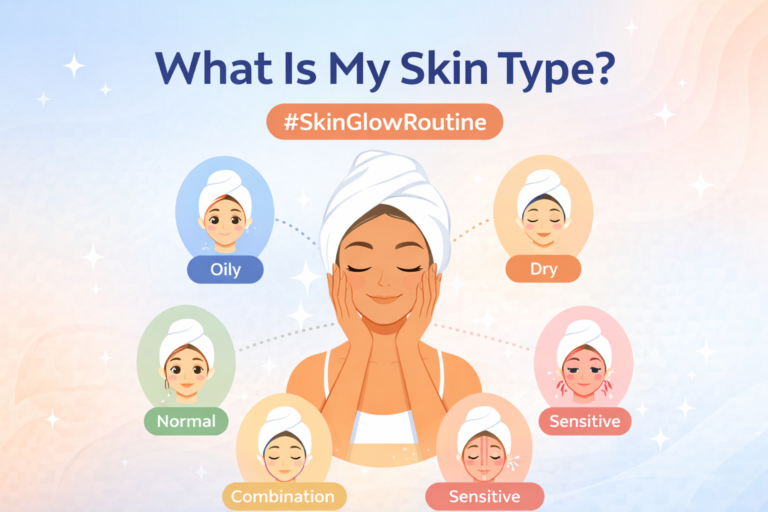
5 Common Skin Types
Let me break this down in the easiest way possible based on real-life signs I’ve personally observed.
1. Oily Skin
I realized oily skin is not just about shine — it’s about excess oil throughout the day.
If your skin:
- Feels greasy a few hours after washing
- Makes your phone screen dirty
- Needs frequent face washing
- Leaves oil marks on tissue
Then you most likely have oily skin.
2. Dry Skin
Dry skin is something I’ve seen many people misunderstand. It’s not just dullness — it’s lack of moisture and comfort.
Signs include:
- Tight feeling after washing your face
- Rough or uneven texture
- Skin that feels stretched when you move your face
- Flaky or patchy areas
If your skin feels uncomfortable without moisturizer, it’s probably dry skin.
3. Normal Skin
Honestly, this is the most balanced skin type.
If your skin:
- Feels comfortable after cleansing
- Is neither too oily nor too dry
- Rarely breaks out
Then you have normal skin. I usually call this the “low-maintenance skin type” because it doesn’t demand too much.
4. Combination Skin
This is actually very common — and a bit tricky.
In my observation:
- Forehead, nose, and chin (T-zone) feel oily
- Cheeks feel normal or dry
If you notice different areas of your face behaving differently, that’s combination skin.
5. Sensitive Skin
Sensitive skin is more about reaction than type.
If your skin:
- Gets red or itchy easily
- Reacts to new products
- Feels burning or stinging
- Gets irritated due to weather or pollution
Then your skin is sensitive.
4 Ways to Identify Your Skin Type
Now comes the important part — how I personally test skin type without overcomplicating things.
1. Bare Face Test
This is the simplest method I use:
- Wash your face with a gentle cleanser
- Don’t apply anything
- Wait for 2–3 hours
Observe:
- Oily shine → oily skin
- Tightness → dry skin
- Balanced → normal skin
- Oily T-zone only → combination skin
2. Tissue Paper Test
This one is super easy:
- Press a tissue on different areas of your face
Results:
- Oil all over → oily skin
- No oil → dry skin
- Oil only on T-zone → combination
3. Skin Reaction Check
I always pay attention to how my skin reacts to products or environment.
- Burns or stings easily → sensitive
- No reaction → normal or other types
4. Touch & Feel Method
Sometimes, just touching your skin tells a lot:
- Sticky → oily
- Rough or uneven → dry
- Smooth and balanced → normal
Can Your Skin Type Change Over Time?
Yes — and I learned this the hard way.
Your skin type is not permanent. It can change due to:
- Weather (summer vs winter)
- Age
- Hormones
- Diet
- Skincare products
For example, my skin feels more oily in summer but slightly dry in winter. That’s why I always adjust my routine based on seasons.
Facts Overview
Here are some important things I’ve realized that most people ignore:
- Skin type and skin conditions are different
- Oily skin can still be dehydrated
- Dry skin can still get acne
- Sensitive skin can exist with any skin type
- Overwashing can worsen oiliness
Understanding these facts helped me avoid common skincare mistakes.
Tips for Managing Each Skin Type
This is where everything comes together. I’ll share what actually works based on skin type.
For Oily Skin
What I follow:
- Use a gentle foaming cleanser
- Avoid heavy creams
- Use lightweight gel moisturizers
- Don’t skip moisturizer (very important)
Also Read: - Best Skincare Routine in Summer for Oily Skin
For Dry Skin
My go-to tips:
- Use hydrating cleansers
- Apply moisturizer on damp skin
- Avoid over-cleansing
- Use nourishing creams
For Normal Skin
Honestly, this is easy to manage:
- Keep your routine simple
- Maintain hydration
- Use sunscreen regularly
For Combination Skin
What works best for me:
- Use different products for different areas
- Lightweight moisturizer overall
- Avoid over-drying oily areas
For Sensitive Skin
This needs extra care:
- Always patch test products
- Avoid strong fragrances
- Stick to simple routines
- Use calming ingredients
Summary
So, if I had to simplify everything I’ve learned:
- Your skin type defines how your skin behaves
- There are 5 main skin types: oily, dry, normal, combination, and sensitive
- You can easily identify your skin at home
- Your skin type can change over time
- The right skincare depends completely on your skin type
Once I understood my skin, everything became easier — from choosing products to avoiding breakouts.
Also Read:
Get Glowing Skin at Home | Natural Skincare Tips
FAQs
1. How do I know my skin type at home?
You can use the bare face test or tissue test — both are simple and effective.
2. Can I have more than one skin type?
Yes, combination skin is exactly that — different areas behave differently.
3. Is sensitive skin a type or condition?
It’s more of a condition, but it can exist along with any skin type.
4. Why does my skin feel oily and dry at the same time?
That usually means your skin is dehydrated, not necessarily oily.
5. How often should I check my skin type?
I personally reassess every few months or when seasons change.

I’m Suma Angari, Founder of SkinGlowRoutine.com and an SEO Executive passionate about digital marketing and skincare. I share SEO tips, blogging ideas, and natural skincare guides to help you grow online and glow naturally.
View All Articles